 On Friday 13 July, Tooks Chambers in association with the Lesbian and Gay Lawyers Association and Camden LGBT Forum will be hosting the final event in their series of events based around the International Day Against Homophobia. The event starts at 7 p.m. and will be held at Tooks Chambers.
The event is a fundraiser supporting international LGBT organisations working in Jamaica (J-FLAG), Latvia (Mozaika), Zimbabwe (GALZ) and Palestine (Aswat). There will also be a showing of Simon O'Corra's short film "Queer Fear: Gay Life, Gay Death in Iraq"
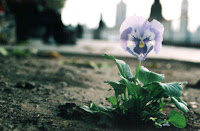
During the course of the evening, pictures from the Pansy Project exhibition will be auctioned. The Pansy Project is an ongoing web based installation by Paul Harfleet where pansies are planted and photographed in locations where homophobic incidents have occurred. Paul has taken the project to a range of locations from Manchester, New York, Margate, the South Bank and Camden. The exhibition at Tooks is the first time that pictures of the Pansy Project have been exhibited in a gallery setting.
Paul Harfleet's work is becoming increasingly well-known. He and his artists' space, Apartment, recently featured in an article in The Guardian.
If you would like to see the images currently exhibited at Tooks, please click on this link.
If you would like to attend please contact natasha.coburn@tooks.co.uk or telephone 020 7841 6100.
If you cannot attend the auction but would like to bid for any of the photographs please contact Natasha.
Pansey Project Charity Auction
Friday 13 July, 7pm
Tooks Chambers
Chambers of Michael Mansfield Q.C.
8 Warner Yard
LONDON EC1R 5EY
Wednesday, July 11, 2007
Pansey Project Charity Auction


Tuesday, July 10, 2007
The Long Road to Decriminalisation

40 years ago this month, a campaiging Welsh Labour MP by the name of Leo Abse managed to guide a Bill through both Houses of Parliament.
By a combination of smart tactics and appealing to politicians to pity those 'less fortunate' than themselves, he got them to agree to a partial decriminalisation of male homosexual relations.
It brought an end to hundreds of years of legal persecution, as Alex Bryce explains.
For many people the so-called swinging 60s was a time of sexual liberation, but for gays and lesbians it was a decade of repression and discrimination.
While their heterosexual brothers and sisters were enjoying their sexual awakening, gripped by the sunny optimism for which the 1960s are remembered, homosexuals were still forced to live in secret, faced with the constant threat of prosecution and imprisonment.
Not until 1967, after a tireless, and often bloody, struggle with the establishment, was male homosexuality partially legalised.
The first significant reference to laws against homosexuality in England occur in 1376, when the 'God' Parliament petitioned King Edward III to banish all "Lombard brokers" and other foreign traders, particularly "Jews and Saracens."
They were accused of introducing "the too horrible vice which is not to be named" which they believed would destroy the realm.
In 1533, when King Henry VIII reformed the church and curtailed the power of the clerical courts, "The Abominable Vice of Buggery" (anal intercourse between two men) first became a criminal offence.
It carried the death penalty and even in the early nineteenth century gay men were still being executed, with an average of two hanged each year between 1806 and 1836.
The laws were finally amended in 1861 after twenty-five years with no executions.
The changes meant that the crime no longer carried the death penalty.
Instead, those found guilty of buggery would be sentenced to life imprisonment.
Attempted buggery carried a 10 year sentence.
In 1885 the Labouchere Amendment was introduced which extended the law to include "gross indecency" (oral sex between two men) which was punishable by a two-year prison sentence.
Although there aren't many recorded cases of executions until the nineteenth century, which could be due to inadequate records, punishments in other countries, particularly British colonies, were more frequent and severe.
Henry VIII’s Buggery Act, which was re-enacted by Elizabeth I in 1563, was adopted in all 13 original colonies, where the crime was punishable by death.
There were, however, many recorded casualties of the anti-gay laws in England in the nineteenth and early twentieth centuries, perhaps the most high-profile being that of Oscar Wilde whose trials in 1895 shook the literary and celebrity world.
The subject of the trial was Wilde's relationship with the promising young poet Lord Alfred Douglas (known as Bosie) which was discovered by Douglas' father, the Marquess of Queensberry.
By 1894 Queensberry had concluded that Wilde was most likely homosexual and became insistent that his young son would stop seeing him.
In a letter to his son in April 1894, Queensberry wrote, "Your intimacy with this man Wilde must either cease or I will disown you and stop all money supplies ... I am not going to try an analyse this intimacy, and I make no charge; but to my mind to pose as a thing is as bad as to be it."
Douglas replied in a telegram: "What a funny little man you are."
As Douglas' relationship with Wilde flourished, his father’s anger became more acute.
In a subsequent letter, Queensberry wrote, "You reptile.. you are no son of mine and I never thought you were."
Douglas answered, "If O. W. was to prosecute you in the criminal courts for libel, you would get seven years' penal servitude for your outrageous libels."
After Queensberry left a calling card for Wilde at a club he frequented which read "For Oscar Wilde, posing sodomite," the acclaimed playwright made the fatal mistake of going to court.
The first of the three trials of Oscar Wilde in April 1895 saw him cheering the prosecution as Queensberry, charged with libel, faced the dock.
The libel trial became a cause celebre as Wilde's association with rent boys, cross-dressers and blackmailers and his affairs with young men began to appear in the press.
Despite his literary friends such as George Bernard Shaw urging him to drop the case, Wilde was determined to persist, despite the damage to his reputation.
Although he had regained some ground while defending the morality of his famous novel, The Picture of Dorian Gray, when challenged on the reason given for not kissing a young servant, Wilde replied: "He was a particularly plain boy - unfortunately ugly - I pitied him for it."
Under cross-examination he started to falter and was eventually forced to drop the case against Queensberry.
Immediately afterwards, a warrant for his arrest was issued for gross indecency and, although the first trial reached no verdict, he was tried again and sentenced to two years of hard labour.
Wilde’s health seriously deteriorated while he was in prison and on his release in May 1987 he was penniless and remained in exile from society.
He died three years later after living under the assumed name of Sebastian Melmoth.
Although the other stories of lives cut cruelly short and damaged by the criminalisation of homosexuality are not as well-known as that of Oscar Wilde, some are equally tragic.
One such case was highlighted by the writer J.R. Ackerley in a letter to The Spectator in 1942 expressing his outrage at a story he had stumbled across in the Welsh town of Abergavenny.
He found that twenty men were put on trial for homosexual behaviour and as a result a nineteen-year-old took his own life by throwing himself in front of a train. Two others endured failed suicide attempts.
The sentences which were issued ranged from one to twelve years.
Despite all the protestations by Ackerley, the subject of the treatment of homosexuals remained unmentionable.
After the Second World War, the number of men being prosecuted for consensual homosexual acts rose drastically from what had been around 500 per year in the 1930s to 1,666 in 1950 and 2,504 in 1955.
Reminiscent of the Salem witch trails and fuelled by the atmosphere generated by the McCarthy period, chain prosecutions became common, with witnesses being offered immunity to name other gay men.
Address books of the accused were trawled through by police resulting in multiple arrests and accusations that they belonged to a 'homosexual ring.'
In the 1950s the anti-gay laws and aggressive police activity in upholding them became the subject of media scrutiny after a series of high-profile arrests.
In 1953 Labour MP William Field was arrested and charged with 'importuning men for an immoral purpose' and as a result lost his Parliamentary seat.
Soon after actor Sir John Gielgood was arrested in a public toilet, having been discovered in a compromising position with a soldier.
The following year, after reporting a theft to the police, Lord Montagu was arrested and eventually sent to prison along with two of his close friends, one of whom was his cousin.
However, in the aftermath of this famous trial, the public mood began to shift.
This was reflected in a Sunday Times editorial published just a few days after the trial concluded.
It argued that the case for law reform regarding "acts committed in private by adults is very strong."
Soon after, the House of Lords held the first ever debate on homosexuality in Parliament which, in turn, lead to the Wolfenden Committee being set up by the Home Secretary, David Maxwell-Fyfe.
Incidentally, Maxwell-Fyfe led the opposition to law reform in the Lords, so it is ironic that immediately afterwards he commissioned the Wolfenden Committee.
It is likely that he assumed that the Committee would find against law reform, but what he didn’t realise that Sir John Wolfenden himself had a gay son who openly wore make-up.
The Wolfenden Committee sat for three years and strongly recommended that homosexual acts in private should no longer be illegal and recommended that the age of consent should be set at 21.
However, the basis for the Committee’s argument was that the law was impractical and a waste of police time rather than that it was unfair or immoral.
Its conclusions made frontpage headlines which in turn projected the debate onto the national stage and on the whole the press coverage was favourable with the exception of the right-wing, low-brow press.
The Guardian described the report as "a fine piece of work" and even the conservative Telegraph called it "courageous."
Some historians see Wolfenden as a key turning point, a watershed which led the eventual law reform which came ten years later.
Others argue that the Committee’s influence was limited and that the ten years of campaigning which followed were key to securing decriminalisation.
However, whatever people say about Wolfenden and its limitations, it certainly set the stage for reform of the law.
It also became clear that public opinion was starting to change.
In 1958, the Lord Chamberlain overturned the ban on plays with homosexual themes, which paved the way for a series of hugely influential gay-themed works and, in turn, contributed to the gradual change of public mood.
Soon after Wolfenden’s report was published, several attempts were made in Parliament to introduce legislative reform acting on its conclusions.
In 1960 there was a motion in the House of Commons calling on the Government to take early action to implement legal reforms.
This proposal was easily defeated by a Conservative Government reluctant to act for fear of a backlash from the right-wing tabloid press.
Incidentally, Margaret Thatcher, who later became a sworn enemy of gay community, was among the few Conservatives who voted in favour of implementing Wolfenden’s recommendations.
Another watershed development in the march toward decriminalisation was the establishment of the Homosexual Law Reform Society.
Its principle aim was to persuade parliamentarians to decriminalise homosexual acts.
Its first public meeting was held in London in 1960 and attracted over a thousand people, which was astonishing given that to be openly gay was to flout the law.
When the Tory Government was defeated by Labour in 1964 and determined reformer Roy Jenkins was appointed Home Secretary the prospects for future legal reform looked brighter for the gay community.
However, Labour only had a tiny majority in Parliament, which left them in a precarious position.
Therefore, on the surface, they were almost as reluctant to pursue legal reform as the Tories had been.
One particularly startling feature of the push for legal reform in the Sixties, which draws a stark contrast with recent gay rights legislation, was that in Parliament the House of Lords led the way.
In 1965, Lord Arran, an elderly peer who was considered somewhat eccentric (he had a pet badger), sponsored a Private Members Bill in the House of Lords which proposed the enactment of the Wolfenden recommendations.
The Bill eventually ran out of parliamentary time and was therefore shelved, but it did contribute significantly to the growing pressure on the Commons and the Government to reform the law.
After a failed attempt by a Conservative MP, Humphrey Berkley, Leo Abse tabled a 10-Minute Rule Bill in July 1966 which was supported by Home Secretary Roy Jenkins.
The tone of the debate which ensued in Parliament was particularly offensive to homosexuals.
Opponents of decriminalisation referred to gays as "disgusting," "loathsome" and "not real men," and even those supporting decriminalisation seemed to do so out of a patronising sense of pity more than anything else.
When Abse's bill decriminalising homosexuality crawled through the final stages in Parliament forty years ago last week, it was a shabby and wholly unsatisfactory thing which did little apart from decriminalising homosexual acts in private.
The age of consent was set at 21 (compared to 16 for heterosexuals) and the maximum penalty for any man committing 'gross indecency' (any sexual acts including masturbation and oral sex) with a 16 to 21 year-old was raised to five years.
The bill also only decriminalised male sexual relationships in private, which meant that many men were still convicted for 'procuring' (which amounted to chatting someone up in a bar) and 'soliciting.'
Despite the change in the law, gay men were not given legal equality and continued to be imprisoned for actions which would not have been criminal if there partner was a woman. I
In fact, between 1967 and 2003 up to 30,000 gay men were convicted for behaviour that would not have been illegal if they were heterosexual.
Yet, to give a fair assessment of the 1967 Sexual Law Reform Act, we have to take a closer look at the context.
The Labour Government were in a precarious position and were so preoccupied with holding onto power that they would never see the reform as a priority.
Additionally, as Abse himself claimed recently in an interview in The Observer, the supporters of the bill had to use all their political acumen to drag it through a parliament which was still, on the whole, hostile.
If the age of consent had not been set at 21, then perhaps the bill would have never been passed. This inevitably meant making concessions.
The passing of the act paved the way for increasing social, if not political, liberation for the gay community.
Gay publications such as Timm and Spartacus were launched and the Committee for Homosexual Equality was formed, which began to lobby for a lower age of consent.
Eventually, after much opposition, even from Abse himself, gay social networks were formed.
Despite its significant limitations and its distinct lack of ambition, the Sexual Law Reform Act drastically changed the lives of a generation of innocent gay men who were imprisoned for behaviour which was completely natural to them.
As with the more recent reforms, in fighting for equality, it was crucial to stay within the mainstream, which often necessitates being less ambitious and taking baby steps rather than giant leaps towards the eventual goal.
As a gay rights campaigner, that is the most difficult, and perhaps the most tragic, part of fighting to put right injustice and prejudice in our society.
Seeing the Act as a watershed for gay rights is perhaps overestimating its influence, but I am certain that it was the first of many small steps along the forty-year road from criminality and shame to equal rights and pride.
With thanks to PinkNews.co.uk
Monday, July 9, 2007
Meek 60's
 1967 was undeniably an important year for gay rights. The change in the law however came too late for some.
On 3 February of that year, the pioneer record producer and songwriter, Joe Meek killed himself, aged 37. Arguably he was mentally ill, suffering from paranoia. His homosexuality, at a time when it was illegal, and the police's interest in him in respect of the "suitcase murder" (that of Bernard Oliver whom Meek had known) were probable factors in his decision to end his own life.
PopMatters, an online magazine of cultural criticism, celebrates Meek, who released 245 singles, as some sort of warped musical genius, doing its best to avoid his disappearance in the sound archive of history.
[...] he built the first TV in his town, was an RAF radio engineer, a technician with the Midlands Electricity Board, and before branching out on his own was a BBC sound engineer. He did not last at the BBC because his methodology of altering recordings was completely at odds with tradition. So, in his rooms above a leather goods store at 304 Holloway Road in London, Meek became Britain’s first independent record producer, pioneering special effects, tape reversal, direct imput of the bass guitar, close-mic’ing, and multi-tracking.Read the full article here:
Carry on Compressing!: Joe Meek and 1960s Britain
Sunday, July 8, 2007
Gay Wheels
 Le Tour de France is in London Town this week-end. Throngs of people are taking advantage of the blocked off streets in the centre of town and even the sun has decided to put in a appearance.
This is as good an opportunity as any to take a look at cycling from a gay perspective.
The world of sports is regretably notorious for its latent (and sometimes overt) homophobia, which prevents athletes from being out and proud. Cycling is no exception to this it seems. There does not appear to be any out male competitors although well informed rumours abound. Women seem to be faring marginally better with a few high profile women visibly wearing the rainbow jersey.
Below is a short list of some of these pioneers compiled thanks to Outsports and their list of out athletes.
Judith Arndt
Cycling
In 2004 she won the World Road Race Championship and the Olympic Silver Medal in the road race. She is a member of the T-Mobile women team.
She is partnered to Petra Rossner, herself a former professional cyclist.
Michelle Dumaresque
Mountain Biking
Michelle Dumaresque is a transgendered (male to female) mountain bike racer whose provincial downhil mountain biking race license was taken away from her when Cycling British Columbia found out she was not born a woman. Michelle took the case to the international level: the UCI (International Cycling Union - based in Switzerland). The UCI told her that she was allowed to race the downhill professionally, in the women's category.
Missy Giove
Mountain Biking
An out and proud lesbian, Giove, 28, has been called the Michael Jordan of her sport and has won world mountain biking championships. She also has competed on ESPN's X-games. She is a a long term relationship Kristen Wilson.
Nicole LaViolette
Cycling
LaViolette, an accomplished competitive cyclist, is an assistant professor of law at the University of Ottawa.
Ilana Lobet
Cycling
An acomplished cyclist, Lobet was featured as part of a gay and lesbian team in the ECO Challenge endurance event in Fiji.
Andrea Ratkovic
Duathalon
Nicknamed "The Rat," Ratkovic excels in the duathalon, which incorporates running and cycling.
Andrea's website
Andrea's competitive website
Useful Links:
* CycleOut
* Dykes on Bikes
* Gay Cycling Touring Group
* Gay Cycling and Tours
Saturday, July 7, 2007
Trans Treatment Satisfaction Survey
 One of the greatest obstacles to developing and improving medical services around transition in the UK is a lack of solid research data about patient experiences and outcomes. Anecdotal accounts often suggest that problems exist but, until now, no rigorous research has been undertaken to capture and classify people’s actual experiences (good and bad) across the board.
The Department of Health, under guidance from the trans workstream of its Sexual Orientation and Gender Identity Advisory Group (SOGIAG) wants to remedy that information gap and has created a confidential online survey for trans people to report on their experience.
Further information and details on how to take part are available here.
Friday, July 6, 2007
George Melly: singer, writer, fisherman, 'tart'

George Melly 1926 - 2007
George Melly, jazz musician, writer, bon viveur and bisexual, who was born on 17th August 1926, died yesterday 5th July 2007. Melly had been suffering from lung cancer but he refused all treatment and carried on delighting his fans on stage. His last performance was only four weeks ago. He was also suffering from dementia.George was an early hero of the gay rights movement with his openness about his own ambiguous sexuality, told with such humour and affection in his autobiography Rum, Bum and Concertina.
He was also a long-time supporter of secularist causes, not only as a vice president of the Gay and Lesbian Humanist Association (GALHA) but also an honorary associate of the National Secular Society.
Read his obituary here:
* The Guardian
* BBC
* The Telegraph
* The Independent
* Goodbye to the good times, The Observer
* 'I hope I die before I get (very, very) old', Melly in his own words
View pictures here
Thursday, July 5, 2007
Lecture: Daphne du Maurier
 To mark the centenary of her birth, the National Portriat Gallery is hold a lecture examining the life of Daphne du Maurier, author of many bestselling novels including The Breaking Point(1959) and The Birds, which was later adapted to become a successful Alfred Hitchcock film in 1963.
Sunday 8 July, 15.00
National Portrait Gallery
Ondaatje Wing Theatre
Speaker: Sylvia Paskin
Admission free
Wednesday, July 4, 2007
Equal Power 2028
 2028 will mark the centenary of the Equal Franchise Act, which gave women the vote on equal terms to men. Yet today women are still missing from positions of power.
Research from Cranfield business school shows that, in 2007, women hold just 7.2% of all FTSE 100 directorships. Non-executive women directors are making slightly better inroads into male-dominated boardrooms, having achieved 10% of top non-executive seats. But only one woman has made it to CEO, and only one woman chairs a FTSE 100 board.
Women working full-time are paid on average 17% less an hour than men (or 38% less if they work part-time)
Yesterday, 3rd June, The Fawcett Society, the UK's leading campaign for equality between women and men established in 1866, launch their new campaign called Equal Power 2028. Its aim was to demands for the next 21 years so that equality between women and men can finally be achieved.
The event which featured an address and Q+A with Barbara Follett, Minister for the East of England and Parliamentary Under-Secretary of State in the Department for Work and Pensions and member of the Fawcett Society. This was preceded by short service and wreath laying ceremony at Westminster Abbey commemorating the life of Millicent Fawcett, the founder of the Society.
Click here for more information.
Fawcett Society website
Tuesday, July 3, 2007
LGBT History Month at Pride London
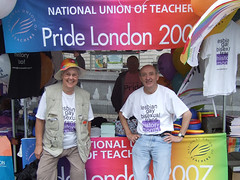
We hope to have a presence at all the Pride events nationwide.
Please look out for us and pay us a visit. We are very keen to hear what you think of LGBT History Month and how we can work to improve it.
The photo shows Sue Sanders and Paul Patrick, Co-Chairs of LGBT History Month in front of our very colourful stall.
Monday, July 2, 2007
Beautiful Things
 From 6 July 2007, anyone visiting the revamped home of the British Film Institute on the Southbank in London will be able to view an extraordinary diversity of films and TV programmes exploring queer identities across the last century.
In the dark old days of British film and television any appearance from a lesbian or gay man was something to celebrate – even if they tended to be predatory bull dykes in sensible shoes or screaming nancy boys with a taste for angora.
On 27 July 1967 the Sexual Offences Act became law, finally decriminalising consensual sex between two men in private. To mark the 40th anniversary of this step towards greater equality, Beautiful Things offers 100 films and television programmes that chronicle and explore queer representation and identities over the last century. All titles are available to view absolutely free via the Mediatheque, a new resource that opens the treasures of the BFI's unique collection to the public.
The Beautiful Things collection features landmark dramas such as Victim (1961), The Naked Civil Servant (1975) and Oranges Are Not the Only Fruit (1990). Perhaps more significantly, Beautiful Things makes available films, TV dramas and documentaries that have been unavailable since their first release or broadcast.
Thirty years ago many of us cringed when Larry Grayson and John Inman minced around on primetime TV. Times have changed. Or have they? Revisit or discover the icons, the trailblazers and the tortured souls of yesteryear and decide for yourself.
Highlights from the new Mediatheque collection have also brought together to be shown for free in the Studio throughout July (starting on the 1st). This programme includes extracts from London Town (1946), featuring a remarkably gay turn from Sid Field; The Naked Civil Servant (1975), starring a purple-haired John Hurt as Quentin Crisp; and Jane Horrocks appearing as a learner lesbian in Came Out, It Rained, Went Back in Again (1991). Click here for times of showing.
Beautiful Things will form the focus for Generations of Love – a year-long collaboration between the Mediatheque and the London Lesbian and Gay Film Festival in partnership with the Mayor of London. Generations of Love will provide a space for older members of our communities to share experiences through film, discussion and reminiscence.
Highlights of the collection:
Women’s Rights (1899)
Two second rate Victorian transvestites strut their stuff.
First a Girl (1935)
Jessie Matthews dons a tuxedo in the great cross-dressing musical comedy.
A Taste of Honey (1961)
Murray Melvin stars as Rita Tushingham’s gay best friend in the Salford-set classic.
This Week: Lesbians (1965)
British lesbians finally get a TV programme to themselves.
Edward II (1970)
Ian McKellen delivers British TV’s first gay kiss.
Girl (1974)
Alison Steadman gets steamy under the surplus blanket with Corporal Harvey.
Inappropriate Behaviour (1987)
A psychologist finds herself drawn to her 15-year-old pupil (Charlotte Coleman).
The Lost Language of Cranes (1992)
Nature or nurture? A father and son discover they have something in common.
It’s Not Unusual (1997)
Potent and moving series based on the testimonies of British lesbians and gay men.
Torchwood (2007)
Bringing the collection up to date… Captain Jack falls in love with a handsome young squadron leader.
British Film Institute


